



Overview
Bagasse is the fibrous residue left after extracting juice from sugarcane or sorghum stalks, representing approximately 30% of the original sugarcane weight. For every 10 tons of sugarcane processed, nearly 3 tons of wet bagasse are produced. This by-product is commonly repurposed for biofuel generation, pulp manufacturing, and building materials — making it a valuable renewable resource.
However, moisture content plays a crucial role in determining the efficiency and usability of bagasse. With natural moisture levels ranging from 40–50%, it is often too wet to burn effectively as fuel. MoistTech’s IR-3000 Near-Infrared (NIR) Moisture Sensor provides precise, real-time moisture analysis to optimize drying, improve energy recovery, and reduce operational costs.
Why Measure Moisture
The IR-3000 is engineered for industrial durability and precision. Designed to provide reliable measurement despite variations in material height, color, and particle size. Each system is pre-calibrated for the customer’s material and application before shipment, with a non-drift optical design that eliminates the need for recalibration.

Boiler Efficiency

Fuel Value & Combustion Performance

Drying, Handling & Storage

Real-Time Process Integration
RECOMMENDED MEASUREMENT LOCATIONS
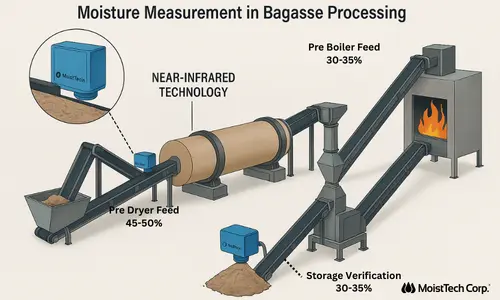
Post-Extraction / Pre-Dryer Feed:
Immediately after the sugarcane is crushed, moisture levels in the bagasse average 45–50%. Measuring at this stage allows operators to assess the raw material’s condition and adjust feed rates to the dryer or boiler accordingly.
Post-Dryer / Pre-Boiler Feed:
This is the critical control point for energy efficiency. The target moisture for combustion should be reduced to 30–35%, which ensures consistent ignition and optimal burning rates.
Too dry → Rapid burning, higher ash generation, and potential overheating.
Too wet → Slower ignition and incomplete combustion.
Boiler Feed or Storage Verification:
Monitoring the final moisture before bagasse enters the boiler or is transferred to storage ensures stable combustion and long-term usability. Maintaining 30–35% moisture maximizes thermal value and reduces maintenance on furnace systems.
The IR-3000 sensor can be installed at multiple points in the process — including the entrance to the boiler, over conveyors, inside hoppers or silos, or on screw conveyors. Typical installation height is 4–12 inches above the material. Moisture readings are displayed via touch-screen interfaces or connected directly to plant control systems for automated process management.
By integrating MoistTech’s IR-3000 sensors into bagasse production, sugar and biofuel plants can significantly enhance process control, reduce energy consumption, and maximize combustion efficiency. Continuous online moisture monitoring ensures consistent product quality, reduced waste, and a measurable return on investment through improved fuel performance and operational reliability.
Understand the Process
Bagasse uses include creating a biofuel to recycle our waste products into renewable energy. It is often burned to provide energy to the sugar mills. However, the high moisture content of bagasse, usually about 40-50%, is detrimental to its use as a fuel. Drying the bagasse can significantly enhance its energy production.