


Glass Wool Moisture

Overview
Glass wool, made from fine fibers of glass, is widely used for insulation in buildings, appliances, and industrial applications. Moisture content in glass wool must be carefully controlled during its production, as excess moisture can affect the material’s insulating properties, leading to inefficiency and potential clumping.
The IR-3000 Near-Infrared (NIR) Moisture Sensor provides an effective, real-time solution for monitoring moisture content throughout the production process.
Why Measure Moisture
Accurate, real-time moisture monitoring delivers multiple process and product benefits.

Quality Assurance

Energy Efficiency

Reduce Waste

Process Stability
RECOMMENDED MEASUREMENT LOCATIONS
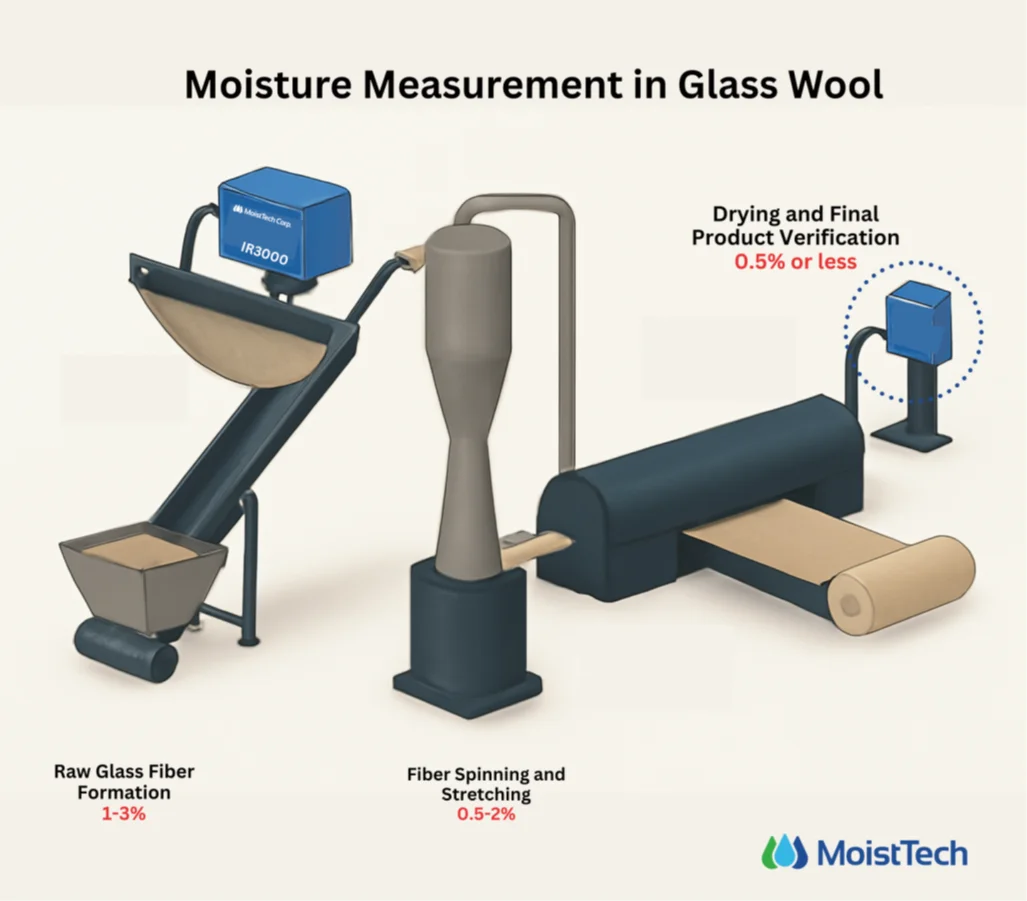
1. Raw Glass Fiber Formation (Pre-Processing Stage)
Moisture Range: 1–3%
Sensor Placement: Immediately after the raw glass fibers are created and are in the initial stages of cooling.
Benefit: The moisture sensor ensures that the fibers are in the proper condition for further processing, preventing issues like clumping or inconsistent texture.
2. Fiber Spinning and Stretching
Moisture Range: 0.5–2%
Sensor Placement: During the fiber spinning and stretching process, when the fibers are further processed and cooled.
Benefit: Ensures that moisture content is controlled during fiber formation, maintaining uniformity and quality of the fibers.
3. Drying and Final Product Verification
Moisture Range: ≤ 0.5%
Sensor Placement: After the glass wool fibers have been fully formed and dried, just before packaging or further insulation use.
Benefit: Verifies that the final glass wool product meets the required moisture specification, ensuring that it retains its insulating properties and is suitable for packaging or installation.