


Carbonless Coating Moisture

Overview
Carbonless copy paper (CCP) relies on precise coating chemistry and controlled moisture levels to produce clean, accurate image transfer without carbon sheets.
The production process uses microencapsulated dye coatings (CB) and reactive clay/phenolic coatings (CF/CFB) applied to base paper at tightly controlled weights.
Why Measure Moisture
Accurate, real-time moisture monitoring delivers multiple process and product benefits.

Quality Assurance

Energy Efficiency

Reduce Waste

Process Stability
RECOMMENDED MEASUREMENT LOCATIONS
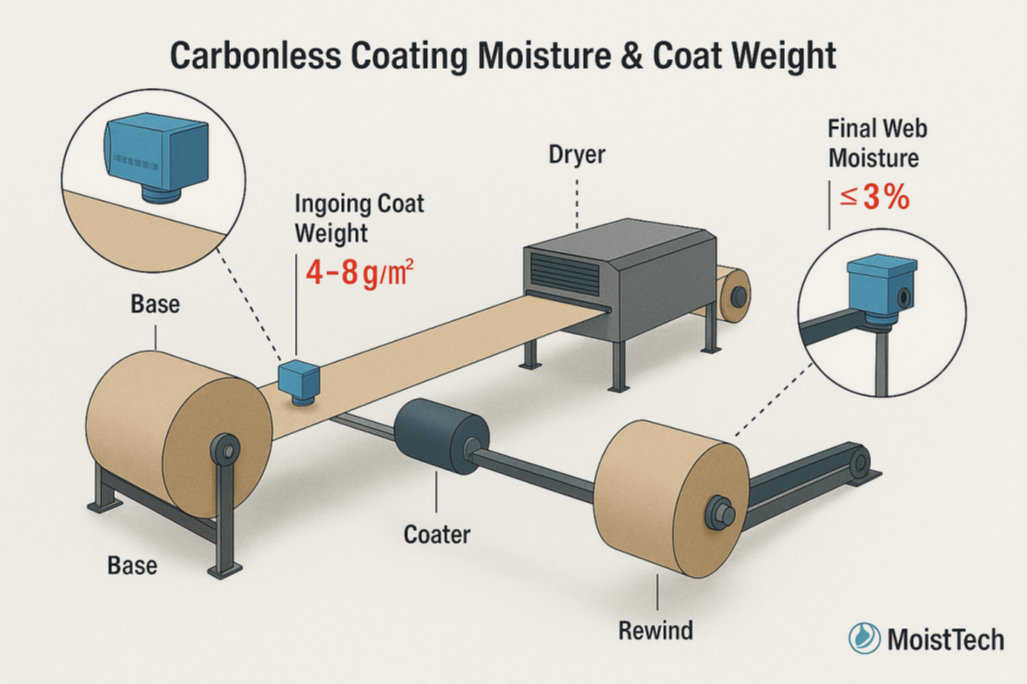
BASE SHEET MOISTURE – PRE-COATER:
Before coating, base paper moisture significantly influences coating absorption, coat weight distribution, and curing behavior. Typical base sheet moisture levels range between 4–7%. Measuring at this stage ensures consistent binder pickup and prevents uneven penetration.
WET COATING / POST-APPLICATION
Directly after the carbonless coating is applied (CB or CF), coat weight uniformity is essential for proper chemical reaction performance. The IR-3000 can measure:
-
Wet moisture percentage
-
Wet coat weight (gsm)
-
Coating thickness uniformity
Typical wet coat weights vary by formulation:
-
CB coats: 4–7 gsm
-
CF coats: 1–3 gsm
-
CFB coats: 3–6 gsm
NIR feedback here enables closed-loop metering rod, gravure, or air knife adjustments.
POST-DRYER / FINAL WEB MOISTURE
After drying and curing, final web moisture must be controlled to prevent:
-
Curling
-
Brittleness
-
Poor imaging performance
-
Reduced sheet strength
Final target moisture for coated CCP is typically 4–6%. Coating uniformity, final coat weight, and moisture stability at this stage ensure the product performs consistently in printers, bindery equipment, and manual writing applications.
Understand the Process
Using the IR-3000, you’ll save money throughout the entire production process, while making the best quality product at the same time. With MoistTech, you don’t need to compromise.