



Overview
Alfalfa (Lucerne) is one of the most widely grown forage crops in the United States, valued for its high protein content, digestibility, and versatility as both animal feed and biofuel. Consistent moisture control is essential to preserve nutritional value, prevent spoilage, and improve processing efficiency.
MoistTech’s IR-3000 near-infrared (NIR) moisture sensor provides real-time, non-contact, continuous moisture analysis, allowing operators to monitor and control drying and pelletizing processes with precision.
Why Measure Moisture
Accurate, continuous moisture control during alfalfa processing provides several engineering and operational advantages:

Quality Assurance

Energy Efficiency

Reduced Waste

Process Stability

Safety
Typical Moisture Ranges
| Process Stage | Optimal Moisture Range |
|---|---|
| Pre-Dryer Feed | 65 – 75% |
| Post Dryer / Pre-Baling | 10 – 15% |
| Final Product | 10 – 12% |
RECOMMENDED MEASUREMENT LOCATIONS
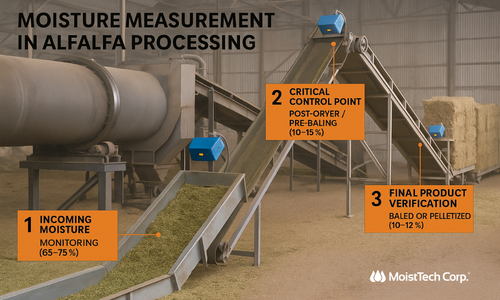
Pre-Dryer Feed Material:
Installing the sensor before the dryer enables monitoring of incoming moisture in the freshly cut or chopped alfalfa. Feed material typically enters with 65–75% moisture depending on field conditions. Monitoring here helps optimize dryer temperature and airflow for energy efficiency.
Post-Dryer / Pre-Pelletizer:
This is the critical control point for product quality and efficiency. Measuring after drying ensures material is conditioned properly for pressing or baling.
Too dry → brittle stems, leaf loss, reduced nutritional value.
Too wet → mold growth, combustion risk, and spoilage during storage.
Baled or Pelletized Product (Optional):
Monitoring finished material helps verify consistent moisture before packaging or storage. Maintaining the proper final moisture prevents microbial activity and extends shelf life.
Integrating the MoistTech IR-3000 moisture sensor at key stages of alfalfa production allows for optimal drying control, consistent product quality, and reduced operational costs. Proper moisture management improves feed digestibility, extends storage life, and enhances overall plant efficiency – often providing a full return on investment within 30 days from dryer energy savings alone.