


Moisture Matters
Why precision moisture control has become essential in modern plastics processing.
As processors work with advanced resins, tighter specifications, and more recycled materials, moisture controls has moved from a quality check to a critical process-control strategy.
Moisture in plastic manufacturing has always been a concern. Today, it has become one of the most important variables affecting product quality, production efficiency, and sustainability. As processors work with increasingly sophisticated engineering resins, tighter customer specifications, and growing volumes of recycled material, controlling moisture is no longer just about preventing defects, it is about optimizing the entire manufacturing process.
Even slight variations is moisture content in plastic can influence part appearance, dimensional stability, mechanical performance, and energy consumption. While many processors still rely on traditional drying practices and periodic laboratory testing, leading manufacturers are adopting real-time moisture measurement to gain continuous processing insight and make adjustments before problems occur.
Hygroscopic vs. Non-Hygroscopic Plastics
Moisture sensitivity varies considerably depending on the polymer beinf processed.
Hygroscopic materials including nylon (PA), PET, PBT, ABS, TPU, PC, PLA, and many engineering-grade compounds actively absorb moisture from the surrounding environment. Even after the proper drying, these materials can quickly reabsorb moisture during storage, conveying, or production interruptions.
Non-hygroscopic materials such as polyethylene and polypropylene generally absorb very little moisture internally but can still carry surface moisture that creates processing issues.
Understanding these differences is the foundation of an effective moisture control strategy and a key reason why one-size-fits-all drying practices can fall short.
Why Moisture Has Such a Significant Impact
During processing, moisture becomes much more than water trapped inside a resin pellet.
When hygroscopic polymers are heated to melt temperatures, excess moisture can initiate hydrolysis, a chemical reaction that breaks polymer chains apart. The result is reduced molecular weight and degraded material properties.
Common moisture-related problems include:
- Brittleness and reduced impact strength
- Lower tensile performance
- Poor dimensional stability
- Surface streaking or silver splay
- Bubbles or voids
- Inconsistent viscosity
- Warping and shrinkage variation
- Increased scrap and customer rejects
Ironically, processors often respond by extending drying times or increasing dryer temperatures. While this may reduce moisture, it frequently introduces unnecessary energy consumption and can even damage certain materials through excessive heat exposure.
The goal is not to make resin as dry as possible. The goal is to consistently reach the right moisture level for each material.
Moisture Can Change
Many processors think about moisture only at the dryer, but moisture can fluctuate throughout the material’s journey.
Potential points of moisture variation include:
Material Receiving
Resins may arrive with elevated moisture levels due to transportation conditions, seasonal humidity, or storage prior to shipment
Storage
Open containers, improperly sealed gaylords, warehouse humidity, and long storage periods allow hygroscopic materials to absorb atmospheric moisture.
Drying
Incorrect dryer settings, overload dryers, insufficient residence time, poor desiccant performance, or inadequate airflow can all leave residual moisture in the resin.
Conveying
Long conveying distances, vacuum leaks, and improperly sealed transfer systems may expose dried material to humid air before it reaches processing equipment.
Processing
Production interruptions, hopper residence time, or repeated reheating can allow moisture conditions to change even after proper drying.
Every transition represents another opportunity for moisture variation.
Where Moisture Control Has the Greatest Impact
Virtually every plastics process benefits from accurate moisture control, but several are particularly sensitive.
Injection molding demands highly consistent resin conditions to maintain cosmetic appearance, dimensional accuracy, and repeatable mechanical properties.
Extrusion relies on stable melt characteristics to maintain film thickness, sheet uniformity, profile dimensions, and surface quality.
Compounding requires controlled moisture to ensure additives, fillers, and reinforcing fibers disperse consistently while maintaining targeted material properties.
Film and sheet manufacturers depend on uniform moisture conditions to minimize gels, streaks, thickness variation, and downstream converting issues.
Recycling and reprocessing operations face perhaps the greatest challenge because incoming material streams often vary dramatically in moisture content from batch to batch.
Across each of these processes, moisture directly influences production stability and finished product quality.
Moving Beyond Periodic Testing
Traditional moisture testing methods continue to provide valuable quality assurance information, but they also have inherent limitations.
Many facilities still rely on laboratory moisture analyzers for plastic, loss-on-dryer method, Karl Fischer titration, or periodic sampling from dryers or process lines.
While accurate, these techniques share one common challenge:
They only describe what has already happened.
By the time laboratory results are available, thousands of pounds of resin may have already been processed.
Operators are left adjusting based on historical information rather than current process conditions.
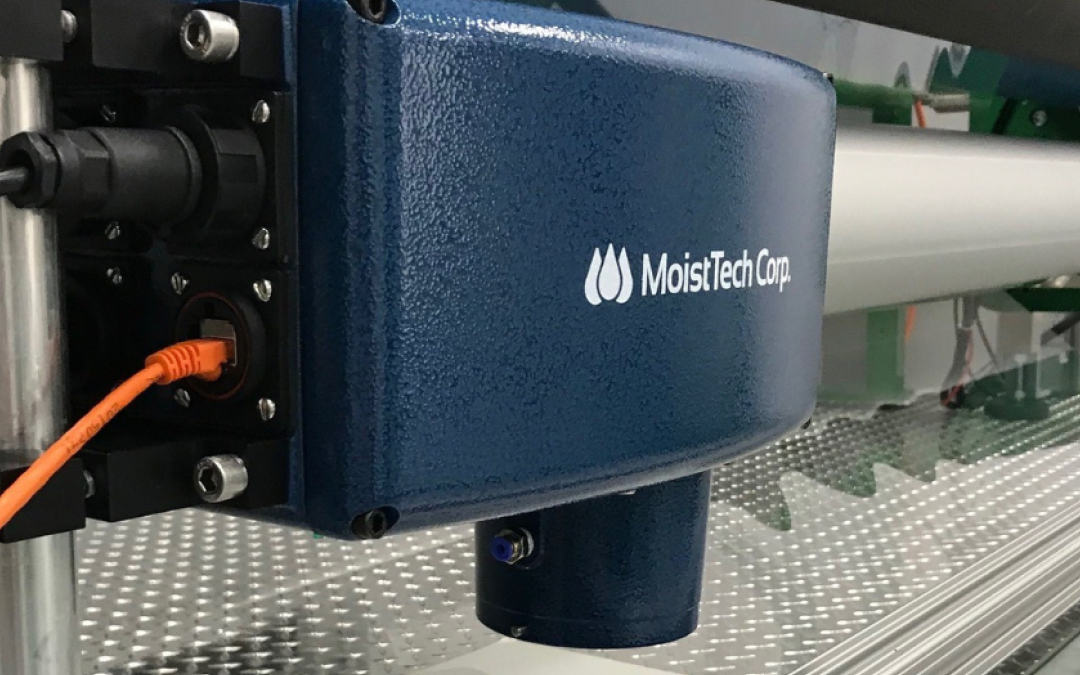
Real-time, non-contact moisture measurement changes this dynamic by continuously monitoring moisture as material moves through production.
Instead of waiting for quality problems to appear, processors gain immediate visibility into process changes and can respond before defects develop.
Turning Moisture Data into Process Control
Continuous moisture information becomes significantly more valuable when it is integrated into everyday production decisions.
Operators can:
- Verify dryer performance in real time
- Detect incoming material variability
- Identify moisture changes before molding or extrusion
- Optimize dryer residence time
- Reduce unnecessary over-drying
- Stabilize product quality
- Minimize operator adjustments
- Improve overall process consistency
Rather than reacting to scrap after it occurs, manufacturers gain the ability to control moisture proactively.
The Growing Challenge of Recycled Materials
As manufacturers incorporate higher percentages of recycled and reclaimed plastics, moisture management becomes increasingly complex.
Recycled materials frequently originate from multiple sources, experience varying storage conditions, and exhibit inconsistent particle size and contamination levels. Moisture variability often becomes significantly greater than with virgin resin.
These fluctuations make periodic sampling less representative of actual process conditions.
Continuous moisture monitoring provides processors with immediate feedback as incoming material changes, helping maintain stable production despite increasingly variable feedstocks.
As sustainability initiatives continue to expand across the plastic industry, this capability will become even more important.
Practical Improvements Without Major Process Changes
Improving moisture control does not always require replacing existing equipment.
Many facilities achieve measurable improvements by:
- Standardizing resin handling procedures
- Keeping containers sealed whenever possible
- Regularly verifying dryer performance
- Reducing unnecessary conveying exposure
- Monitoring incoming material consistency
- Establishing moisture targets for each resin family
- Using continuous moisture data to validate drying performance rather than relying solely on fixed drying times
Small improvements made consistently often deliver significant reductions in scrap, energy consumption, and process variability.
From Measurement to Manufacturing Confidence
Modern plastics manufacturing demands greater consistency than ever before. Customers expect tighter tolerances, improved mechanical performance, and greater sustainability–all while manufacturers work to reduce operating costs.
Moisture measurement has evolved from a laboratory quality check into a valuable process control tool that helps manufacturers improve efficiency throughout production.
MoistTech works with plastics processors worldwide to implement real-time, non-contact near-infrared moisture measurements across resin and coverting applications.
In addition to supplying instrumentation, the company’s application specialists support installation strategy, measurement location, calibration development, and ongoing process optimization to help plants improve both product quality and operational efficiency.
As plastics processing continues to evolve, one principle remains constant: the better manufacturers understand moisture throughout their process, the prediction, efficient, and profitable that process becomes
Plastic Moisture Applications
MoistTech is an industry leader with over 40 years of experience in moisture measurement and control technology. Learn more about how MoistTech can improve your efficiency and quality in plastic moisture applications