


Drying is one of the most critical – and energy intensive – stages in many converting processes. Whether producing paper, board, coatings, films, labels, or other web-based materials, manufacturers need enough heat and dwell time to achieve the desired finished product without sacrificing quality, throughput or energy efficiency.
The challenge is that dryer settings tell you what the equipment is doing. They don’t necessarily tell you what is happening to the product.
Changes in incoming moisture, coating weight, line speed, ambient conditions or raw materials can alter drying requirements throughout a production run. When operators lack real-time information about the material itself, the natural response is often to build in a safety margin: more heat, more drying time or slower line speeds.
That may help prevent under-dried product, but it can create another set of problems.
Over-Drying Has a Cost
More drying is not always better.
Excessive drying can increase energy consumption, reduce throughput and negatively affect product characteristics. In moisture-sensitive applications, removing more moisture than necessary can also reduce product weight and yield.
At the other end of the spectrum, insufficient drying can contribute to coating, adhesion, curling, dimensional stability and downstream converting issues.
Periodic laboratory or grab-sample testing remains valuable for quality verification, but it provides a snapshot of conditions that existed when the sample was taken. By the time results are available, hundreds or thousands of feet of material may have already passed through the process.
The goal should be to operate as close to the optimum moisture target as possible – not simply to dry conservatively enough to avoid problems.
Measure the Product, Not Just the Process
Continuous online moisture measurement gives operators visibility into what is happening to the material as production is running.
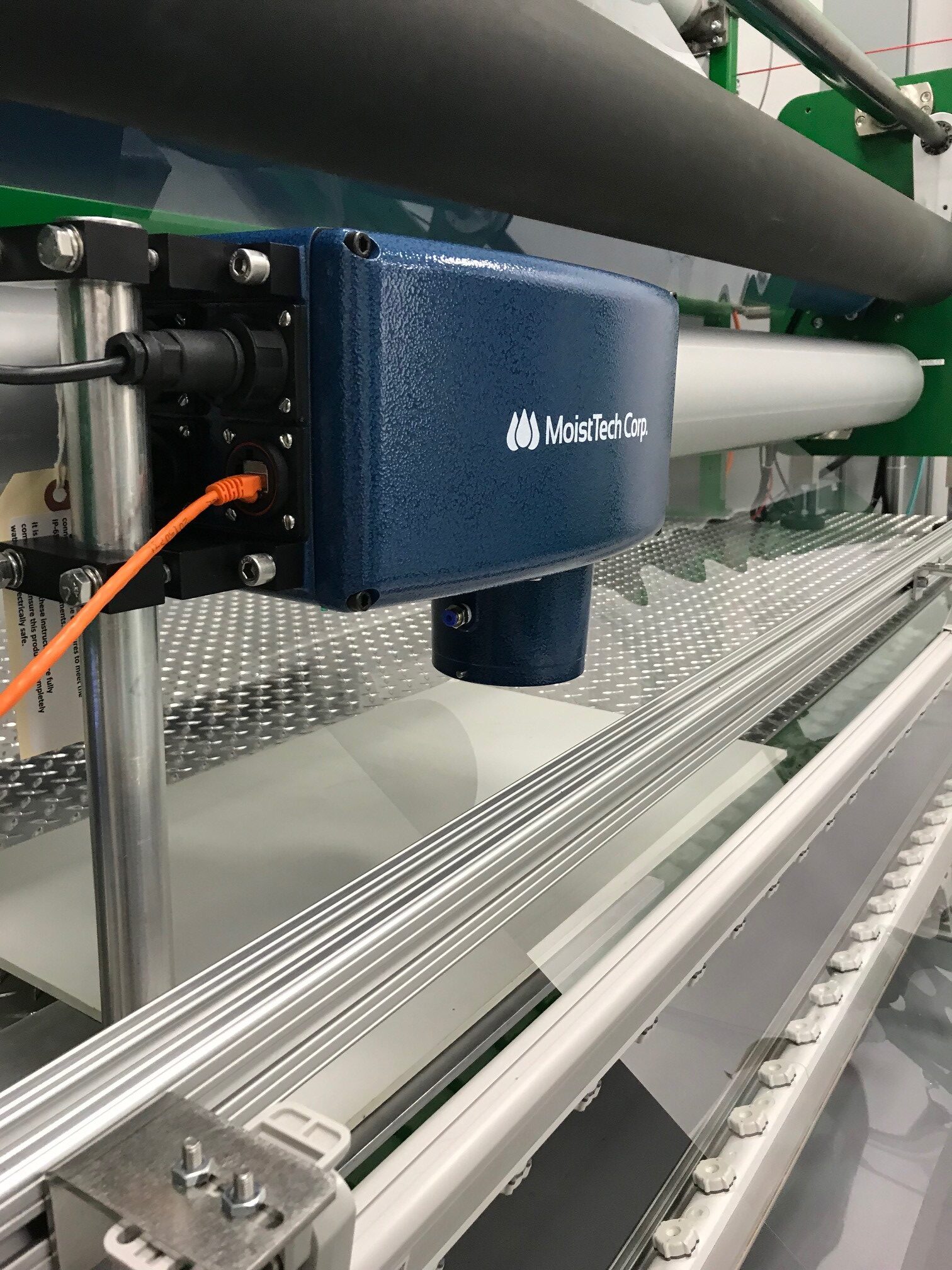
Non-contact near-infrared (NIR) sensors can measure moisture directly on a moving web without touching or damaging the product. Positioned at strategic points in the process, measurements can show how moisture changes before and after drying and provide immediate feedback when conditions begin to move away from the target.
Instead of discovering a moisture problem during final inspection, operators can identify changes while there is still time to correct them.
When moisture data is integrated with a plant control system, those readings can also support adjustments to dryer temperature, airflow or line speed. This creates the opportunity to move from reactive troubleshooting towards continuous process control.
Better Moisture Control Means More Than Better Quality
For converters, tighter moisture control can have an impact well beyond product specifications.
Avoiding unnecessary drying can reduce energy consumption. Detecting variation earlier can reduce scrape and rework. Maintaining a more stable process can improve throughput and reduce the amount of operator intervention required to keep production within specification.
Real-time measurement also provides valuable process data for troubleshooting. When a quality problem occurs, production teams have a continuous record of moisture conditions rather than relying solely on individual samples or operator observations.
Turning Moisture Data Into Process Control
MoistTech’s IR-3000-C Series uses non-contact NIR technology to provide continuous, real-time moisture measurement for converting applications. The sensor can be positioned above or below a moving web and integrated into existing process controls, giving operators immediate visibility into changing moisture conditions.
Pre-calibrated for the customer’s application and designed not to drift, the system provides repeatable measurements without routine recalibration and can store multiple product calibrations for facilities running different materials.
The objective is simple: dry to the product’s actual requirement instead of relying on a safety margin.
For converters facing rising energy costs, tighter quality requirements and pressure to reduce waste, knowing exactly what is happening to the material in real time can turn the dryer from a fixed production setting into a much more precise process-control tool.
Contact MoistTech
Directly: info@moisttech.com or 941-727-1800