


Slag Moisture
Contact Us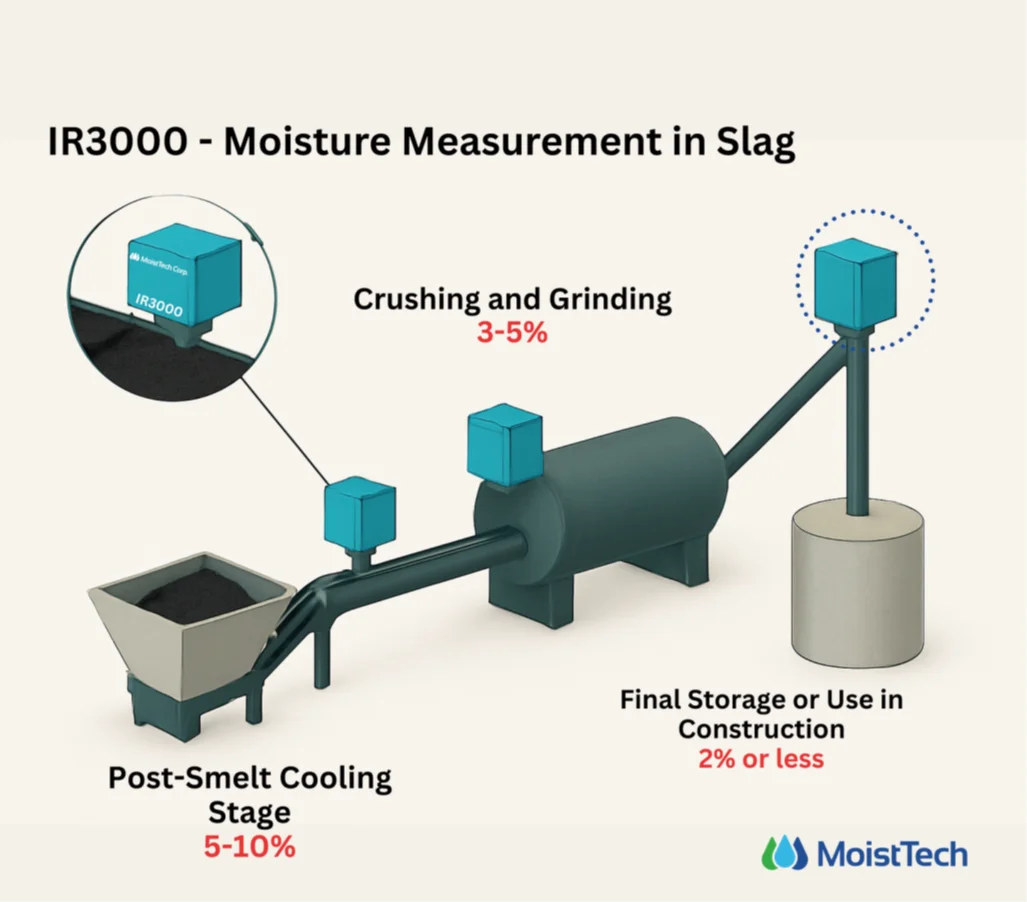

Overview
Slag is a by-product of metal smelting processes and is often produced during the extraction of metals such as iron, steel, copper, and others. Moisture content in slag plays a crucial role in its handling, storage, and further processing. Slag with excessive moisture can lead to clumping, difficulty in handling, and issues in its use as an aggregate or in other applications.
The IR-3000 Near-Infrared (NIR) Moisture Sensor provides a precise, real-time solution for monitoring slag moisture content to optimize processing.
Why Measure Moisture
Accurate, real-time moisture monitoring delivers multiple process and product benefits.

Quality Assurance

Energy Efficiency

Reduce Waste

Process Stability
RECOMMENDED MEASUREMENT LOCATIONS
1. Post-Smelt Cooling Stage
Moisture Range: 5–10%
Sensor Placement: After the slag has been removed from the furnace and begins to cool.
Benefit: Monitoring moisture immediately after cooling helps ensure the slag is not too wet or too dry for further handling.
2. Crushing and Grinding
Moisture Range: 3–5%
Sensor Placement: During or after the crushing and grinding processes.
Benefit: Precise moisture monitoring helps ensure slag particles are the correct size and consistency for use as construction aggregate or in other applications.
3. Final Storage or Use in Construction
Moisture Range: ≤ 2%
Sensor Placement: Before the slag is stored or used in manufacturing, such as cement or construction materials.
Benefit: Ensures the final product meets moisture specifications, improving quality control and reducing waste.
Understand the Process
At MoistTech Corp., we utilize only the best technology for your manufacturing needs. Near-Infrared Technology (NIR) allows for a non-contact solution for accurate moisture content readings. This technology is insensitive to variations like particle size, material height, and color.