



Overview
Moisture control is a critical factor in ceramic powder production, directly impacting product consistency, compaction behavior, and overall quality. Maintaining the correct moisture level ensures uniform bulk density, consistent dimensions, and stable performance in the finished ceramic products. Even minor variations in moisture can cause costly production issues—too much moisture leads to soft, misshapen products, while too little results in brittle and fragile materials.
The MoistTech IR-3000 near-infrared (NIR) moisture sensor provides a real-time, non-contact solution for measuring and controlling moisture within ceramic powder processes. By enabling instant feedback and process adjustments, manufacturers can minimize waste, improve quality, and achieve consistent drying and forming results.
Why Measure Moisture
Continuous online moisture monitoring during ceramic powder production provides several key benefits.

Quality Assurance

Energy Efficiency

Reduced Waste

Process Stability
Safety
Typical Moisture Ranges
| Process Stage | Optimal Moisture Range |
|---|---|
| Powder Feed / Mixer Inlet | 12 – 20% |
| Post-Mixer / Pre-Press | 3 – 6% |
| Post-Dryer / Storage | 1 – 3% |
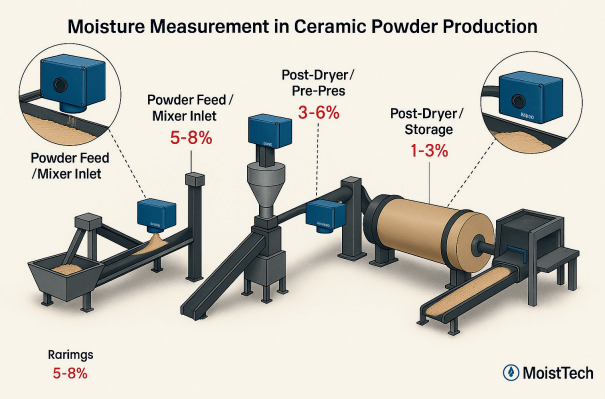
RECOMMENDED MEASUREMENT LOCATIONS
To optimize quality and process control, sensors should be installed at key points in the ceramic powder production process:
-
Sensor 1 – Powder Feed / Mixer Inlet: Measures the moisture of raw powder or clay mix before blending (typically 5–8%).
-
Sensor 2 – Post-Mixer / Pre-Press: Monitors moisture immediately before pressing or granulation (target 3–6%), ensuring proper density and moldability.
-
Sensor 3 – Post-Dryer / Storage: Verifies final moisture of dried powder or granulate (1–3%) before packaging or storage, ensuring long-term stability and optimal kiln performance.
By integrating MoistTech’s advanced NIR technology, ceramic producers can maintain precise moisture control across all production stages, delivering uniform, high-quality ceramic components with maximum process reliability.
Understand the Process
The need for precise clay moisture levels has become a critical component during production. Being such a porous material, clay can easily become either too wet or too dry wasting manufacturers time and money.