



Overview
Moisture measurement in cereal production is a critical step to ensure consistent product quality, taste, and shelf life. Every type of cereal—whether flaked, puffed, rolled, shredded, shaped, hot or cold, sugar-coated, or plain—requires precise moisture control throughout processing to achieve optimal texture and maintain the long shelf life that consumers expect.
Accurate and reliable real-time moisture analysis not only maintains quality but also enhances production efficiency, reduces waste, and optimizes dryer control.
Why Measure Moisture
Accurate moisture measurement in cereal manufacturing is essential.

Quality Assurance

Energy Efficiency

Reduced Waste

Process Stability
Safety
Typical Moisture Ranges
| Process Stage | Optimal Moisture Range |
|---|---|
| Incoming Cereal Mix | 10 – 18% |
| Post-Extrusion / Pre-Drying | 18 – 25% |
| Final Product | 1 – 3% |
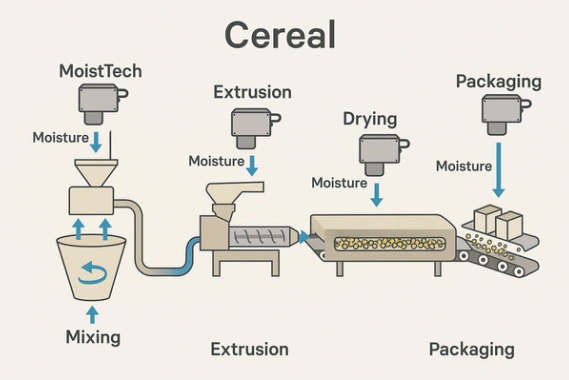
RECOMMENDED MEASUREMENT LOCATIONS
The most beneficial points for moisture measurement and control in cereal manufacturing include:
-
Before extrusion or puffing: To ensure proper dough or mix consistency.
-
After cooking: To verify target moisture levels before shaping or flaking.
-
At dryer output: To maintain uniform dryness and prevent over-drying or brittleness.
-
Before packaging: To confirm moisture stability for extended shelf life.
Installing sensors at multiple points in the process provides full visibility and immediate control, ensuring consistent product performance and cost efficiency.
Understand the Process
We utilize near-infrared (NIR) technology for non-contact moisture content readings. NIR is insensitive to material variations, such as particle size or color and provides continuous readings.