



Overview
Nylon pellets, as raw materials used in plastic manufacturing, are crucial for a wide array of industries. The moisture content of nylon pellets directly impacts their processing, molding, and extrusion into final products. Excess moisture can lead to processing difficulties, product defects, and degradation.
The IR-3000 Near-Infrared (NIR) Moisture Sensor offers a precise, non-contact solution for measuring moisture in nylon pellets during the production process, ensuring that product quality remains high and consistent.
Why Measure Moisture
Accurate, real-time moisture monitoring delivers multiple process and product benefits.

Quality Assurance

Energy Efficiency

Reduce Waste

Process Stability
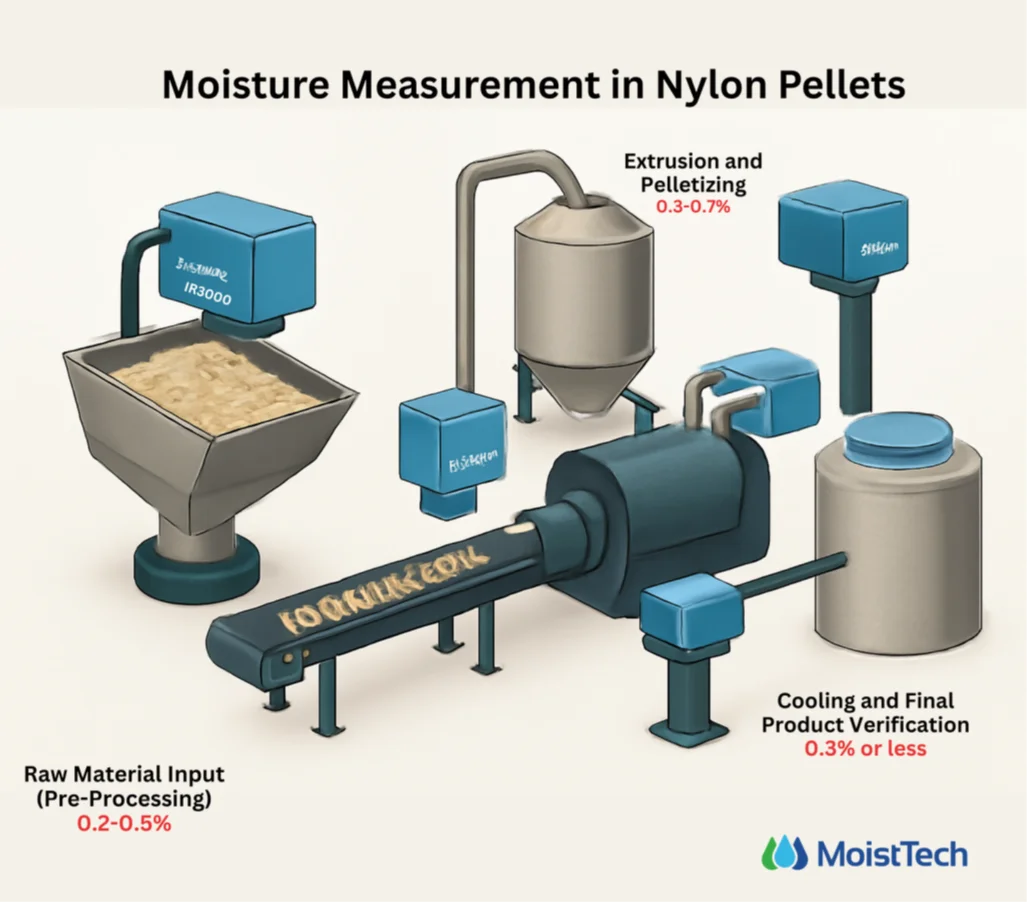
RECOMMENDED MEASUREMENT LOCATIONS
1. Raw Material Input (Pre-Processing)
Moisture Range: 0.2–0.5%
Sensor Placement: The moisture sensor is placed in the hopper or material feed system.
Benefit: Ensures that the raw nylon pellets entering the process have an optimal moisture content to avoid clumping or inconsistent processing during molding or extrusion.
2. Extrusion and Pelletizing
Moisture Range: 0.3–0.7%
Sensor Placement: After the extrusion process, as the material is formed into pellets.
Benefit: The sensor monitors moisture content during the pelletizing process to ensure uniformity in the final product.
3. Cooling and Final Product Verification
Moisture Range: ≤ 0.3%
Sensor Placement: After the pellets have cooled and before they are packaged or sent to the next stage of production.
Benefit: Verifies that the final nylon pellets meet the required moisture specification, ensuring that the pellets are dry enough for storage, packaging, or further use.