

Overview
Why Measure Moisture
The IR-3000 NIR Moisture Sensor offers a reliable solution for moisture control in fiberglass production.

Quality Control
Provides highly accurate moisture
readings, ensuring consistent product quality

Energy Efficiency
Real-time moisture control reduces energy use by preventing over-drying, improving process efficiency, and lowering operating costs

Reduced Waste
By ensuring correct moisture levels
at every stage, manufacturers can reduce waste and
avoid defects caused by improper moisture content

Process Stability
Continuous data allows for
quick adjustments to the process, maintaining optimal
conditions

Safety
Real-time moisture control ensures smoother processing, minimizing production
delays or stoppages
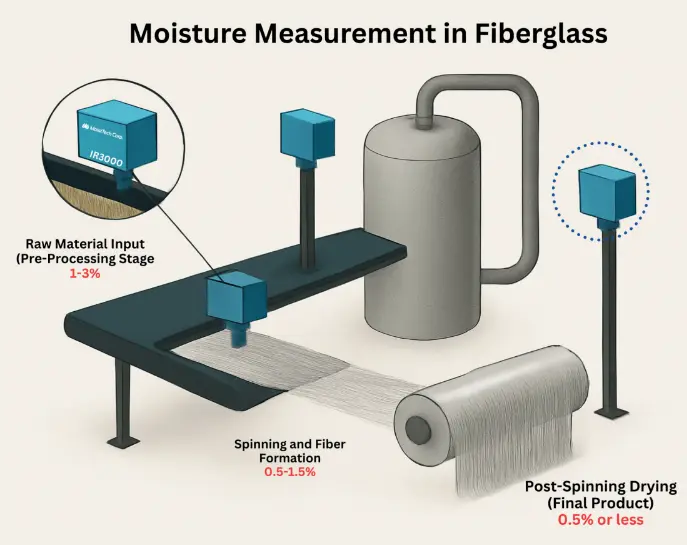
RECOMMENDED MEASUREMENT LOCATIONS
Raw Material Input (Pre-Processing Stage)
- Moisture Range: 1–3%
- Sensor Placement: Positioned at the raw glass fibers’ entry point into the production system.
- Benefit: Accurate moisture readings at the initial stage ensure that the material entering the production line is within optimal moisture limits, preventing issues like clumping or inconsistent processing.
Spinning and Fiber Formation
- Moisture Range: 0.5–1.5%
- Sensor Placement: During or after the fiber spinning process where the glass fibers are drawn and cooled.
- Benefit: Ensuring consistent moisture content during fiber formation prevents variations in fiber strength and ensures uniformity in the final product.
Post-Spinning Drying (Final Product)
- Moisture Range: ≤ 0.5%
- Sensor Placement: After the fibers have been dried or coated, before packaging or further processing.
- Benefit: Final verification of moisture content ensures that the fiberglass is dried to the proper specification before it is rolled or used in further applications like insulation or composites.
Understand the Process
Using the IR-3000, you’ll save money throughout the entire production process, while making the best quality product at the same time. With MoistTech, you don’t need to compromise.