


Dolomite (Talc) Moisture

Overview
Dolomite and talc are key raw materials used in the metallurgical, ceramics, agriculture, cosmetics, and plastics industries. Moisture content directly affects their flowability, packing density, processing, and final product quality.
Dolomite is used primarily as a fluxing agent in steel production and a source of magnesium in various chemical applications. Talc is an essential ingredient in ceramics, paints, coatings, and plastics due to its high stiffness, low moisture, and inert properties.
Maintaining precise moisture levels during processing ensures uniform mixing, improved particle dispersion, efficient handling, and stable processing conditions. MoistTech’s IR-3000 NIR moisture sensor provides continuous, non-contact moisture measurement during processing to ensure optimal product quality and cost efficiency.
Why Measure Moisture
Accurate, real-time moisture monitoring delivers multiple process and product benefits.

Quality Assurance

Energy Efficiency

Reduce Waste

Process Stability
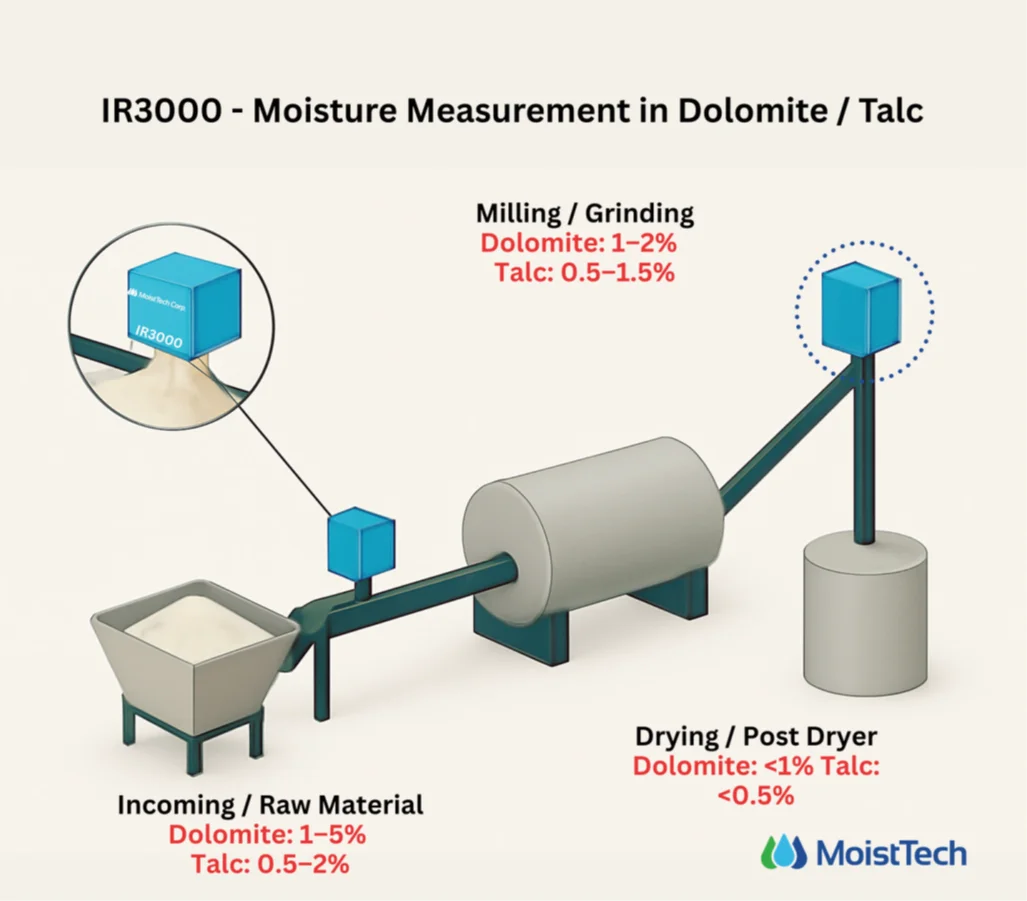
RECOMMENDED MEASUREMENT LOCATIONS
Incoming Raw Material Feed (Crusher/Screen Discharge)
Dolomite and talc often vary in moisture content depending on storage conditions, crushing, and screening processes. Monitoring here ensures:
- Consistent material properties
- Prevents moisture-induced lumping or sticking
- Ensures uniformity in downstream processes
Typical incoming moisture: Dolomite 1–5% / Talc 0.5–2%
Milling / Grinding (Critical Control Point)
Measuring moisture at this stage helps operators:
- Maintain stable milling operation
- Optimize powder consistency and flow
- Prevent over-grinding or under-grinding
Typical moisture after milling: Dolomite 1–2% / Talc 0.5–1.5%
Drying / Post-Dryer Verification (Final Product)
After milling, drying is necessary to reduce moisture and ensure product performance. Moisture must be controlled carefully to avoid:
- Over-drying → product loss, higher costs
- Under-drying → reduced reactivity and performance in final use
Typical final moisture: Dolomite <1% / Talc <0.5%
Understand the Process
All of the product can be inspected with the IR-3000, consistent and reliable adjustments to the moisture can be made in real time during production.