


Ferrite Powder Moisture

Overview
Ferrite powders, primarily used in magnetic applications such as transformers, inductors, electric motors, and permanent magnets, require precise moisture control during manufacturing. Excess moisture in ferrite powder can impact magnetic properties, flowability, pressing characteristics, and final density of the powder.
Controlling moisture during the production and processing of ferrite powder ensures optimized magnetic performance, stable material flow, reduced energy consumption during drying, and improved pressing and molding characteristics. MoistTech’s IR-3000 NIR moisture sensor offers continuous, non-contact, real-time moisture measurement, helping manufacturers achieve consistent powder characteristics and quality control.
Why Measure Moisture
Accurate, real-time moisture monitoring delivers multiple process and product benefits.

Quality Assurance

Energy Efficiency

Reduce Waste

Process Stability
RECOMMENDED MEASUREMENT LOCATIONS
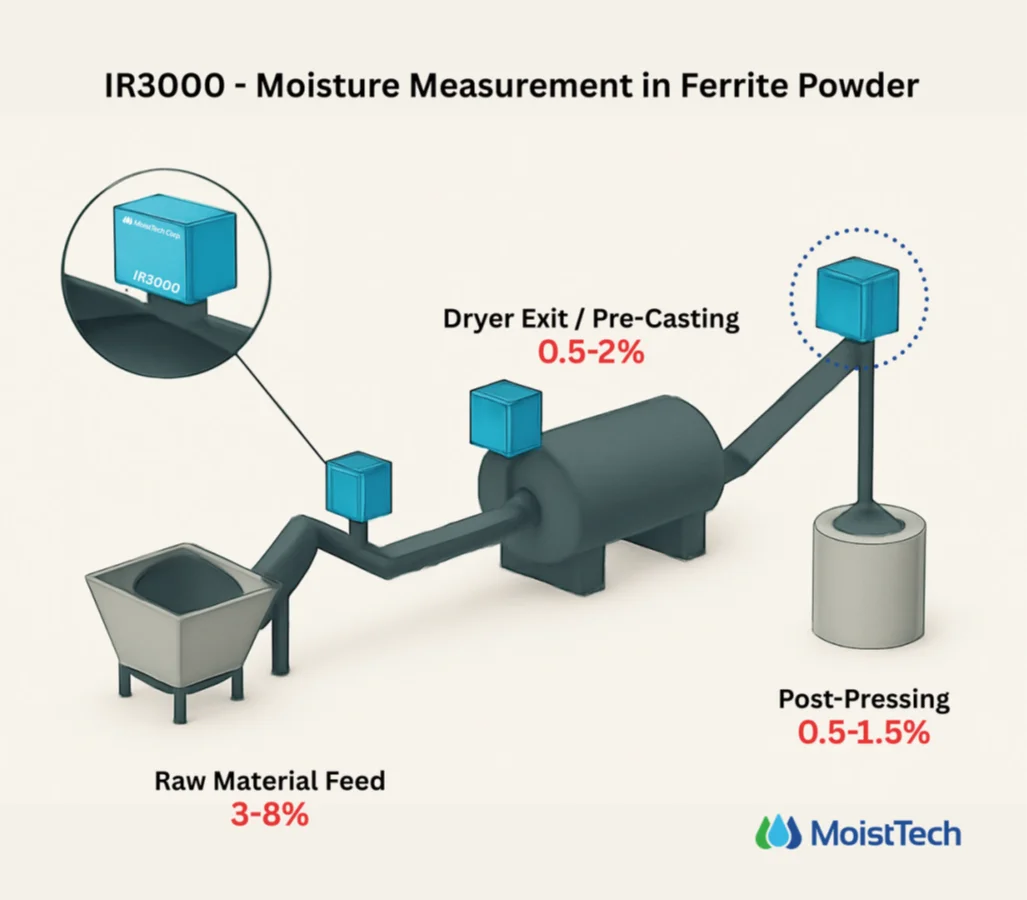
Raw Material Feed
Monitoring moisture at the raw material feed ensures that the blend is within the required moisture range before it enters subsequent stages of processing. Typical incoming moisture: 3–8%.
Dryer Exit / Pre-Pressing (Critical Control Point)
The moisture levels at this stage directly influence:
- Powder consistency
- Pressing uniformity
- Final product quality
Typical moisture after drying: 0.5–2%. Monitoring at the dryer exit ensures optimal moisture content for the next processing stage and prevents over-drying or under-drying, both of which can compromise product performance.
Post-Pressing (Pre-Sintering)
Excess moisture during sintering can lead to porosity, warping, and inconsistent material density. Typical moisture after pressing: 0.5–1.5%. Measuring here stabilizes the sintering process, ensuring the correct physical properties and structural integrity of the final ferrite product.
Understand the Process
Using the IR-3000 drastically cuts production costs. It is energy efficient, low maintenance, and decreases startup and down times. Over dried product causes waste; so does product that is too moist. With the IR-3000, these problems will no longer be an issue.