


Diatomaceous Earth

Overview
Diatomaceous earth (DE) is a naturally porous, highly absorbent material derived from fossilized diatoms. Due to its unique structure, DE can hold up to 150% of its weight in water, making moisture measurement and control a crucial component of its production process. Proper moisture regulation ensures product quality, minimizes processing costs, and prevents shipping inefficiencies caused by excess water weight.
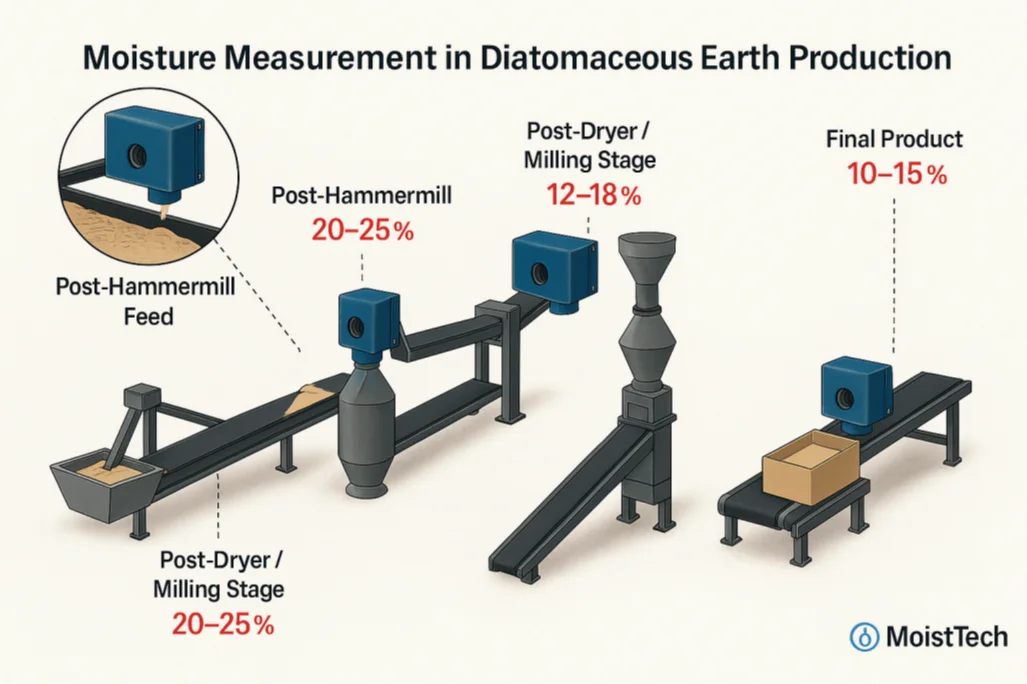
During processing, diatomaceous earth is crushed to an aggregate size using a hammermill, followed by simultaneous milling and drying. In this stage, particles are suspended in a stream of hot gases, and flash or rotary dryers are used to reduce the material’s moisture content to approximately 15%. Maintaining this balance prevents excessive drying, dust formation, and clumping, all of which can negatively impact product consistency and performance.
MoistTech’s IR-3000 Near-Infrared (NIR) Moisture Sensor provides continuous, non-contact moisture measurement directly within the process line, allowing for immediate feedback and control. This enables operators to optimize dryer efficiency, reduce waste, and ensure the final DE product meets exact specifications.
Why Measure Moisture
Accurate, real-time moisture monitoring delivers multiple process and product benefits.

Quality Assurance

Energy Efficiency

Reduce Waste

Process Stability
RECOMMENDED MEASUREMENT LOCATIONS
Sensor 1 – Post-Hammermill Feed
Measures crushed material before drying (typically 20–25%) to optimize dryer input and prevent overloading.
Sensor 2 – Post-Dryer / Milling Stage
Monitors moisture during milling and flash drying (12–18%) to maintain target consistency.
Sensor 3 – Final Product / Packaging
Ensures uniform, stable moisture levels (10–15%) before storage or shipment to prevent reabsorption and freezing issues during transport.
Strategic placement of sensors provides optimal monitoring and control throughout production.